When I was young, I had an encyclopedia, a couple of dictionaries, and a huge atlas in my room. I loved looking things up: checking words, expressions, historical facts, reading about people, countries, and places I had never seen. I loved going to the shelf, open a volume, and start reading letting my imagination flow.
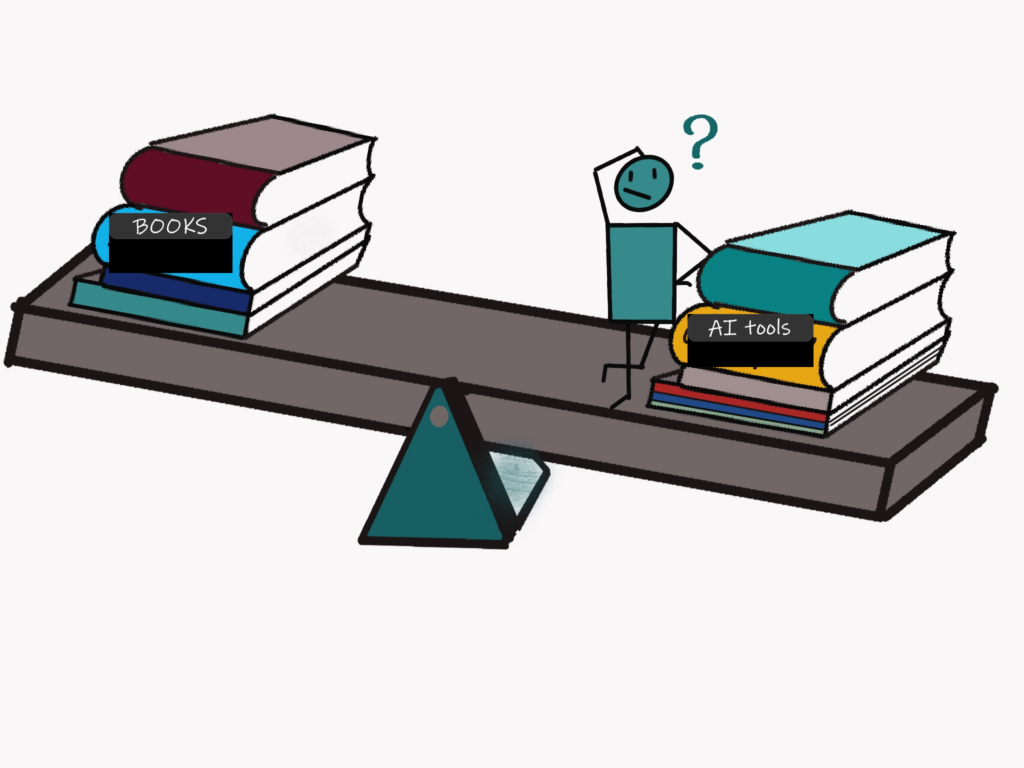
Today, we do the same thing very differently. We google almost everything, or we ask AI tools. We no longer open an encyclopedia, and we don’t unfold big paper maps or browse an atlas either. We use online maps. The act of looking something up is still there, but the medium has completely changed.
We live in a time when almost any question can be answered in seconds. A quick Google search delivers thousands of results, and AI tools can summarize complex topics instantly. In that context, buying a book, whether on paper or as an eBook, can seem unnecessary, even old-fashioned. Why invest time and money in something that takes days or weeks to read when the internet promises immediate answers?
And yet, we believe books remain relevant. For good reasons.
Depth over Immediacy
The main difference lies in depth. Search engines and AI are designed for speed and efficiency. They work best when you know exactly what you’re looking for and need a quick explanation or fact. Books, on the other hand, are not built to answer isolated questions. They are built to develop ideas. A book takes the reader through a subject step by step, offering background and context. Instead of jumping straight to conclusions, it shows how those conclusions are formed. The goal is understanding rather than speed.
As a student at the university in Seville back in the early 90s, I spent much of my time in the library reading, checking, comparing, and finding inspiration. Those books offered something increasingly rare: curated and contrasted knowledge. Very much like a museum curator arranges an exhibit, editors, authors, bookstore owners, or librarians make choices about which books to include, how they fit together, and what message or experience they offer. Therefore, the result is -or should be- a coherent narrative or framework, not a collection of fragments. Online searches often leave us assembling pieces ourselves, while a book usually presents a carefully constructed whole.
Credibility and Accountability
There is also the question of credibility and accountability. Books usually come with a clear author, a publication date, and visible sources. Even when you disagree with the content, you know who is speaking and from which position. With online content, and especially AI-generated responses, this transparency is often missing. Information may be accurate, outdated, biased, or blended from multiple sources, and it can be difficult to tell which is which. Books do not guarantee truth, but they do make it easier to evaluate claims critically.
Fewer Distractions
Another important difference is the reading experience itself. Reading a book encourages focus. There are no notifications, no ads, no links pulling you in different directions. Whether in print or on an e-reader, books support sustained attention -given you can put your phone aside- and deeper reflection. This kind of mental space has real value.
Books also offer stability. Online content changes, disappears, or is constantly updated. A book captures ideas at a specific moment in time. That makes it easier to revisit, cite, and compare with later developments. For anyone interested in how knowledge and language evolve, this fixed reference point is essential.
Books Downsides
Of course, books are not perfect. They can become outdated, especially in fast-moving fields. They cost money, take time and effort to read, and they are not the most efficient way to answer simple or practical questions. If you just need a definition, directions, or a quick refresher, online tools are clearly more efficient.
But this is not a competition where one option must replace the others. Google, AI tools, and books serve different purposes. Online tools are excellent for exploration, discovery, and speed. Books are good at depth, structure, and thoughtful comparison. Used together, they complement each other.
Books are not (only) nostalgic objects, they offer something increasingly valuable: deliberate, reviewed, and critical thinking. Sometimes, slowing down is exactly what allows us to understand more and better.