Artificial Intelligence is rarely a topic that leaves people indifferent.
As announced on our last post, we presented about how AI is changing how we manage projects. Before our recent role model talk, we asked participants a simple question:
“What are your emotional feelings about Artificial Intelligence?”
The responses reflected the uncertainty many people experience today. The dominant emotions were curiosity (10), feeling overwhelmed (8) and optimism (7). There were also feelings of anxiety, skepticism, distrust and caution.
That was precisely why we wanted to have this conversation.
AI is not just for technologists
One of the unique aspects of this event was the diversity of the audience. The room included students, experienced professionals, executives, data scientists, healthcare specialists, marketers and people from many other disciplines.
Rather than presenting AI as a highly technical subject, we explored a much broader question: How is AI changing the way we work—and what does that mean for the projects that drive innovation?
How is AI changing the way we work—and what does that mean for the projects that drive innovation?
The presentation explored why projects are the engine of organisational change, how project systems are evolving from traditional decision support to AI-assisted and increasingly autonomous systems, why ethics and the European Union AI Act are becoming part of everyday project management, how AI is reshaping project management tasks rather than simply replacing project managers, and the new competencies professionals need to thrive in an AI-enabled world.
AI is changing decisions, not just automation
Many people still think of AI primarily as another automation technology.
The discussion challenged this assumption.
Traditional project tools helped people organise information and support decision making. Today’s AI systems increasingly generate options, evaluate risks, draft project plans and assist with complex decisions. As AI evolves toward more agentic capabilities, the role of humans shifts from performing every task to providing judgement, governance and accountability.
While AI is becoming remarkably capable, it still makes mistakes—and sometimes confidently so. That is why expertise matters more, not less. AI can accelerate analysis and generate ideas, but professionals remain responsible for interpreting results, recognising errors, understanding context and making accountable decisions.
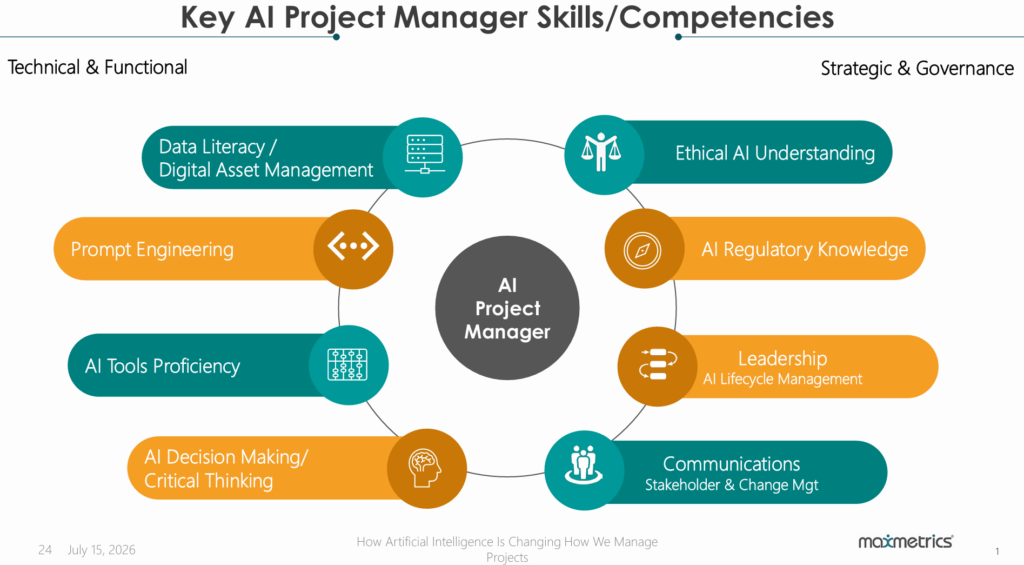
Another topic that generated considerable interest was ethics. We discussed how the European Union AI Act introduces a risk-based approach to AI systems and why project managers, executives and organisations need to understand not only what AI can do, but also what responsibilities accompany its deployment.
Perhaps the strongest message was that AI is creating new competency requirements rather than entirely new professions. Future professionals increasingly need AI literacy, critical thinking, prompt engineering, data literacy, ethical understanding, regulatory awareness, governance, communication and stakeholder management. These competencies complement—not replace—the human capabilities of judgement, creativity and leadership.
Measuring the impact
At the end of the session, we asked participants the same emotional question again.
- Curiosity increased from 10 to 14 responses.
- Optimism increased from 7 to 9.
- Hopefulness increased from 0 to 3.
- Confidence doubled from 1 to 2.
- Skepticism disappeared completely, distrust fell to zero, anxiety decreased, and fewer participants reported feeling overwhelmed. Interestingly, caution increased from 1 to 4.
We see this as a positive outcome because responsible AI adoption requires informed caution rather than blind enthusiasm or unnecessary fear.
Did the session achieve its objective?
We also asked participants how well the session met their expectations. Thirteen said it met their expectations extremely well, three very well, and three moderately well. No participant indicated that the session met expectations only slightly or not at all.
Looking ahead
Artificial Intelligence is no longer a topic reserved for computer scientists. It is becoming part of every profession, every organisation and every project. The future will belong not simply to those who understand AI technology, but to those who can combine human judgement with AI capabilities responsibly, ethically and effectively.
The question is no longer whether AI will become part of your profession. The question is what role you want to play when it does.