On Sunday, August 23, Gloria will present research on accountability in artificial intelligence projects at the FedCSIS 2026 conference in Riga, Latvia, while also helping facilitate two sessions of the Information Technology for Business and Society (ITBS) track.
Presenting in the ITBS track
Gloria’s presentation, Accountability Mechanisms in AI Projects: An Empirical Analysis of Governance, Performance Control, Delivery, and Misconduct Management, will be delivered on Sunday:
Sunday, August 23, 2026 | 09:00–11:00 | Room 108
Session Chairs: Gloria Miller and Christian Leyh
Presentation: 09:35–10:00
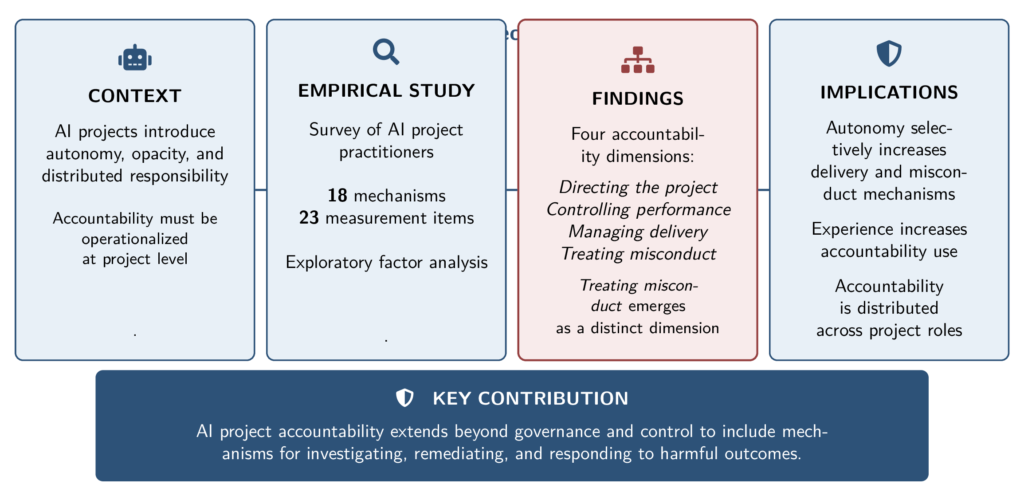
Her research examines how accountability is operationalized in AI projects and how it is shaped by system autonomy, project experience, and the distribution of organizational roles. The graphical abstract below provides an overview of the study, its empirical approach, key findings, and implications.
The presentation is part of a broader ITBS track exploring how emerging technologies are being implemented within organizations and society. The program includes research on low-code/no-code adoption, LLM-supported property valuation, and GIS-based approaches to urban parking.
Facilitating the ITBS track
Later that morning, Gloria will join Zane Bicevska in chairing the combined ITBS and Information Systems Management (ISM) session:
Sunday, August 23, 2026 | 11:30–13:30 | Room 108
Session Chairs: Gloria Miller and Zane Bicevska
The track focuses on the interaction between technology, people, organizations, and society, with presentations addressing inclusive and user-centered design, digital accessibility, industrial interfaces for users with limited digital literacy, and cultural influences on FinTech innovation.
From AI Governance to Project Practice
Together, the sessions highlight a broader challenge facing organizations adopting AI and other emerging technologies: technological innovation must be considered alongside the people, governance structures, and societal environments in which systems are developed and deployed.
Gloria’s presentation contributes to this discussion by bringing accountability into the AI project environment and examining how governance principles can be translated into project practice.
We look forward to the discussions at FedCSIS 2026 in Riga.